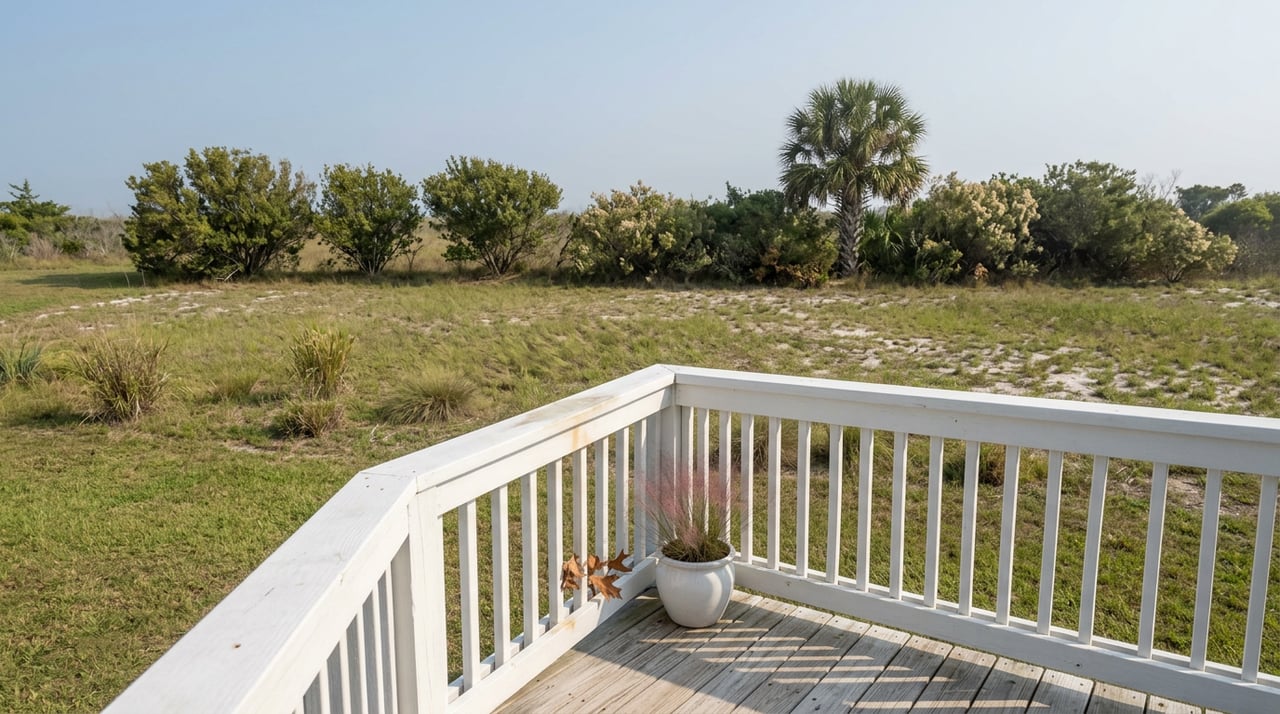
Discovery Sands Development and Jamaica Beach Buyers
August 13, 2026
August 13, 2026
In February, Jeffory Blackard stood in front of the Jamaica Beach City Council and took a question he clearly didn't love. A council member asked him straight: would his development push up home prices and worsen traffic on the West End. Blackard didn't dodge it. "I can't win on that question," he said, before adding that any development out there would do both.
That exchange happened in the wrong building. Jamaica Beach's council could ask all the questions it wanted, but the land in question sits just outside town limits, inside the City of Galveston. The people who would actually decide the fate of Discovery Sands were seven council members meeting under a different roof entirely. On June 25, they voted 4-3 to approve it.
If you're comparing lots or listings on the West End right now, that vote is the fact everyone will mention and almost nobody will explain. Here's what actually changed, and why it matters more for how you buy than for whether prices go up.
Discovery Sands sits on roughly 350 acres off Bob Smith Road and San Luis Pass Road, also known as FM 3005, right next to Jamaica Beach. The June 25 vote granted developer Blackard Companies a Planned Unit Development overlay, a zoning tool that lets a project follow its own custom rulebook instead of Galveston's standard land development code. According to The Daily News, that overlay covers roughly 170 acres of the tract, with the remaining acreage, mostly wetlands, left undeveloped.
The final unit count depends on which document you read. The Daily News's own coverage of the June 25 meeting cites 568 residential lots. A separate outlet's account of the same approval describes the finished plan as approximately 800 homes and condominiums. An environmental group's action alert lists 733 lots plus 213 condos, which works out closer to 950 units. The plans also include a 44-slip marina, a 3.5-acre lagoon, and a lazy river reported at either around 1,200 feet or closer to 200 feet, depending on the source. Even the developer's own height allowance has been reported two ways: 75 feet for architectural features in one filing summary, and up to 120 feet once roof structures and screening are factored in, according to opponents' reading of the same paperwork.
None of that fuzziness is unusual for a project this size moving through amendments over several months. What matters for a buyer is the direction all of those numbers point: bigger than first proposed, taller than standard Galveston zoning allows, and built under private rules the city agreed to in exchange for the project happening at all.
The timing of the vote tells you something the vote total doesn't. Galveston held municipal elections on May 2, and three of the city's seven council seats went to a runoff after no candidate cleared 50 percent. Jamaica Beach residents, including council member Brandon McDermott, asked Galveston to delay its Discovery Sands vote until after the June 13 runoff, arguing the sitting council didn't yet reflect what voters wanted. The city agreed to wait. The runoff happened. The new council was seated. And on June 25, it approved the project anyway, 4-3.
That sequence matters because it closes off the easiest explanation for what happened: that an outgoing or lame-duck council rushed a decision residents didn't have a real say in. Voters had their say. The council that resulted from it still voted yes.
The Daily News editorial board put the underlying math plainly before the vote even happened: Galveston has been growing its tax base at 1 percent or less annually, and most of the same candidates who ran for council this spring campaigned on holding the line with no-new-revenue tax rates. A project the scale of Discovery Sands is one of the few things that could move that number. The council wasn't just weighing wetlands against rooftops. It was weighing a stated political promise against the only realistic way to pay for it.
For anyone watching the West End for a future purchase, that's the piece worth carrying forward. This wasn't a one-time fight the city lost its nerve on. It was a fiscal decision the city had reasons to make again.
Jamaica Beach's population sits at just over 1,000, according to the 2020 U.S. Census, as reported by The Daily News in its coverage of the June 25 vote. McDermott and fellow resident Heather Owens have both pointed to the same physical constraint, described in Houston Public Media's reporting: one stoplight in front of Jamaica Beach services the entire west end of the island, and it's already a bottleneck on ordinary weekends. It also happens to be the only evacuation route off that stretch of the island during a storm.
The Daily News did the arithmetic on what Discovery Sands adds to that road. At the development's planned residential lot count and an assumed 12 occupants per unit, the project could host as many as 7,000 people on a single busy weekend. Even a more conservative estimate of eight occupants per unit puts nearly 5,000 people on site at once. Either number is several times Jamaica Beach's entire year-round population, funneling through the same road, the same stoplight, on the same weekends.
Resident Kim Schovajsa raised a related concern at the February hearing before Jamaica Beach's own council: turning open, absorbent land into rooftops and pavement changes where storm water goes. Blackard's response was that the development would be engineered so floodwater drains into Galveston Bay rather than into the city. That's a design commitment, not a completed drainage study, and it's worth treating it that way until the permitting process bears it out.
Here's the detail that surprised me most in the planning record. Discovery Sands' own governing documents impose short-term rental restrictions tighter than what most individual homeowners in the area operate under: occupancy capped at 12 guests per unit, quiet hours from 10 p.m. to 7 a.m., a required local property manager with a 60-minute response time, and escalating fines up to $5,000 for violations. The development's property owners association can suspend or revoke a unit's rental privileges outright.
If you already own, or are considering buying, a rental property in Jamaica Beach, it's worth reviewing how the town's existing short-term rental rules compare. The point isn't that Discovery Sands is stricter out of civic virtue. A large master-planned community with a marina and a lazy river has strong incentive to keep its own units from becoming the reason a homeowners association gets sued or a city tightens its ordinance island-wide. Whether that self-imposed discipline holds once units start changing hands is a different question, and one worth watching if you plan to hold a rental nearby for the long term.
Discovery Sands still needs to clear additional permitting and regulatory review before anyone breaks ground, and as of the June 25 approval, no construction start date has been announced. Mayor Pro Tem Aaron Renick noted back in February that the property didn't yet have wastewater treatment infrastructure or a permit to build. That's an actual prerequisite, not paperwork. Charter fishing captain Scott Hickman spoke in favor of the project at the June 25 meeting specifically because Blackard has committed to building a new wastewater treatment facility for the broader West End, an upgrade that could ease a real constraint on future building anywhere nearby, Discovery Sands included.
That cuts both ways for a buyer. A new wastewater plant serving the West End is genuine infrastructure that benefits more than one project. It's also the kind of capacity expansion that tends to enable more building once it exists, not less.
If you're weighing a canal lot against a bay or beachfront parcel on the West End this year, proximity to the Discovery Sands site should factor into that decision the same way flood zone or elevation does: not as a reason to avoid the area, but as a variable that changes what a normal Saturday, and a hurricane evacuation, will look like from that specific address. A lot a mile from the site experiences this differently than one that shares a fence line with it.
Has Discovery Sands broken ground yet? No. As of the June 25 approval, the project still needs additional permits and regulatory sign-off, including on wastewater infrastructure. There's no announced construction start date.
Does this change flood insurance for existing Jamaica Beach homes? Nothing in the public record so far indicates a rate change tied to this specific approval. Drainage design for Discovery Sands itself, and whether it performs as engineered, is worth tracking as permitting proceeds.
Could this happen again on another parcel? The council's own reasoning, tied to a thin annual tax base and a no-new-revenue rate pledge, suggests the incentive to approve large projects on the West End didn't disappear with this one vote. Treat this as a precedent, not a one-off.
Buying on the West End has always meant weighing lifestyle against logistics, the view against the drive. Discovery Sands just made the logistics side of that equation a little more concrete, and a little more worth asking about before you sign anything.
If you're sorting through what a specific West End address means for your evacuation route, your rental plans, or your resale timeline, Shani Atkinson has been walking Jamaica Beach buyers through exactly this kind of local detail for years. Discover island living, and get the full picture before you buy, by reaching out to start your search.
Stay up to date on the latest real estate trends.
With deep island knowledge and a client-first mindset, Shani helps you navigate the Galveston market with confidence—delivering clarity, communication, and exceptional outcomes.